
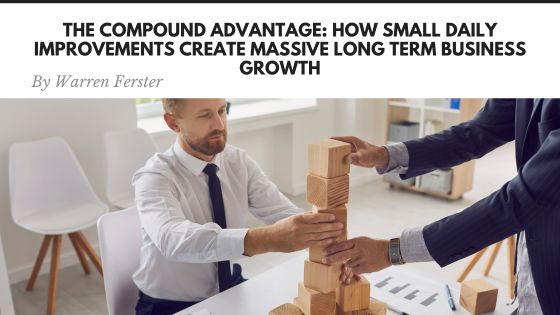
In business, major breakthroughs often get the most attention. Large product launches, big marketing campaigns, and rapid expansion strategies are seen as the primary drivers of success. However, sustainable long-term growth is often built in a much quieter way. It comes from small, consistent improvements made every day. This is known as the compound advantage, where incremental progress accumulates over time to create significant results.
Companies that understand and apply this principle gain a powerful edge over competitors who focus only on short-term wins.
Understanding the Power of Compounding in Business
Compounding is the process where small gains build on each other over time, creating exponential growth. In business, this can apply to operations, customer experience, marketing, and team performance.
A one percent improvement in efficiency, communication, or customer satisfaction may seem minor in isolation. However, when these improvements are repeated consistently, they create meaningful transformation. Over months and years, these small gains multiply and significantly impact overall performance.
The key insight is that progress does not always need to be dramatic to be effective.
Small Improvements in Operations
Operational improvements are one of the clearest examples of compounding in action. Streamlining a single workflow, reducing unnecessary steps in a process, or improving communication between teams can save small amounts of time each day.
Individually, these savings may seem insignificant. But across hundreds of tasks and employees, the accumulated impact becomes substantial. Over time, the organization becomes faster, more efficient, and more scalable without requiring large structural changes.
Customer Experience as a Compounding Driver
Customer experience is another area where small improvements have a powerful long-term effect. A slightly faster response time, a clearer onboarding process, or a more personalized interaction can enhance customer satisfaction.
Satisfied customers are more likely to return, spend more, and recommend the business to others. This creates a compounding cycle of retention and referral that drives organic growth. Each positive interaction strengthens the relationship, making future interactions even more valuable.
The Role of Culture and People
Compounding is not limited to processes and systems. It also applies to organizational culture and employee development. When teams are encouraged to improve continuously, even in small ways, performance gradually rises across the organization.
For example, consistent learning, better communication habits, and small improvements in collaboration all contribute to stronger team dynamics. Over time, these cultural improvements create a more engaged, capable, and high-performing workforce.
Why Consistency Matters More Than Intensity
One of the most important aspects of the compound advantage is consistency. Large, one-time efforts can create temporary spikes in performance, but they rarely lead to sustained growth. In contrast, small improvements made consistently become part of how the business operates every day.
This steady approach reduces volatility and builds resilience. It allows organizations to grow without relying on constant major changes or disruptions.
Conclusion
The compound advantage shows that long-term business success is rarely the result of one big move. Instead, it is the outcome of many small, intentional improvements made consistently over time.
Businesses that embrace this mindset focus on progress over perfection. By improving just a little each day, they create momentum that builds into significant and lasting growth.